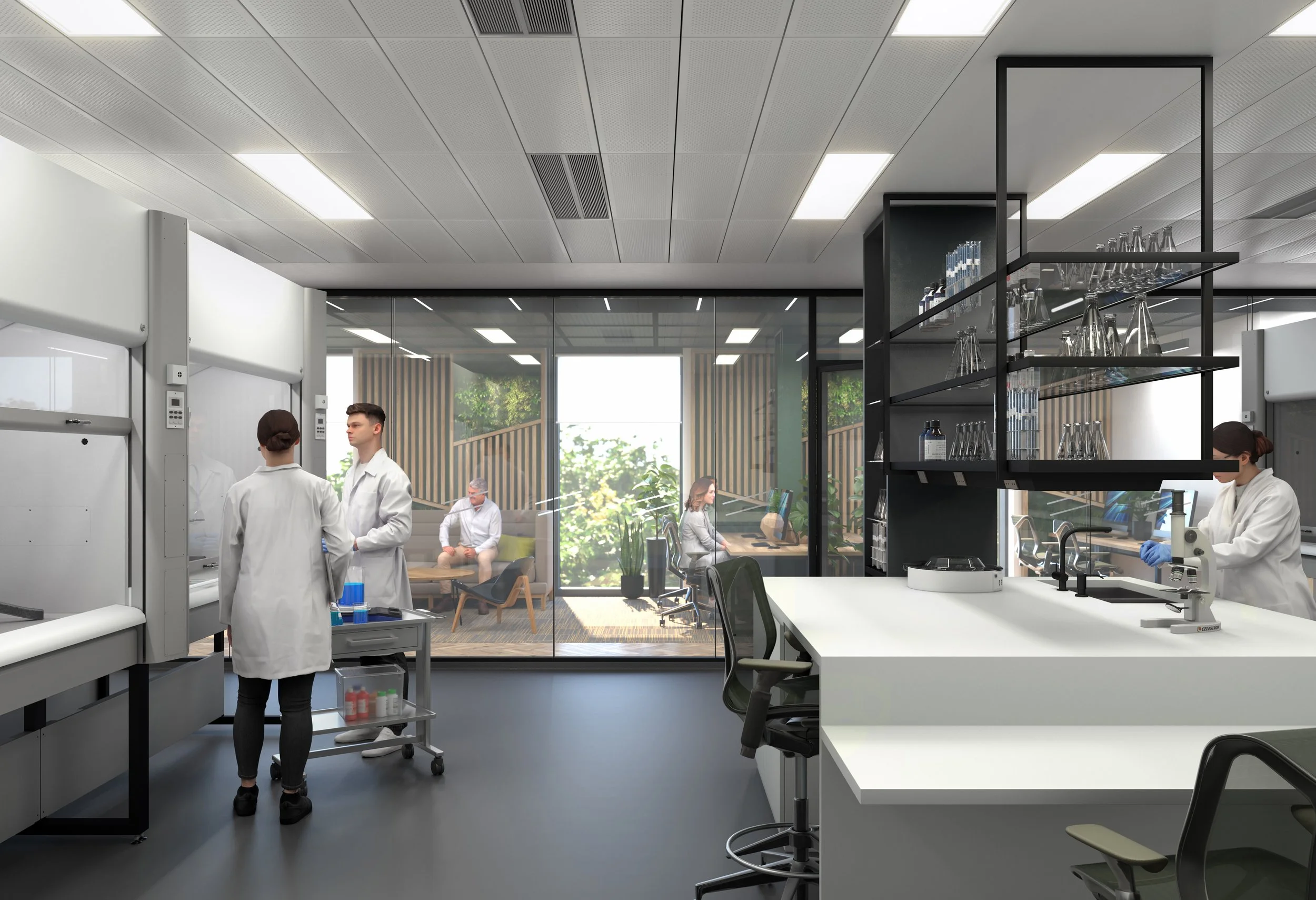
In 2026, flow cytometry has become an operational backbone for many Cambridge life science organisations. It underpins decisions in immunology, oncology, cell therapy, infectious disease, and biomarker development, and it increasingly sits inside programmes that demand reproducibility, traceability, and predictable throughput. That shift has consequences for real estate and facility strategy. A flow cytometry capability is no longer defined only by the instrument specification. It is defined by whether the surrounding environment sustains instrument performance, biosafety governance, sample integrity, and data quality at scale.
From a third party perspective, a useful way to frame flow cytometry laboratory design is as an infrastructure choice with measurable implications. Space requirements are not driven primarily by square metres per instrument. They are driven by the number of distinct risk and workflow states a company must operate simultaneously: clinical sample receipt, preparation and staining, acquisition, sorting with aerosol controls where applicable, decontamination and waste handling, plus secure data review. The physical separation and environmental stability needed across those states is what creates the real demand for space and for building capability.
The instrument trend that is reshaping space expectations
One driver of modern cytometry space demand is the growth of high parameter analysis. Manufacturers now market systems capable of very high dimensional detection, with BD describing the FACSymphony A5 as enabling simultaneous detection of up to 50 parameters. This matters because high parameter cytometry tends to increase sample preparation complexity, panel design effort, and the need for disciplined controls. More controls translate into more bench time, more cold storage, more waste, and often more concurrent workstreams.
At the same time, cytometry is increasingly deployed in two modes that have different facility implications:
Analysis focused cytometry, where the primary constraints are throughput, temperature stability, and routine instrument uptime.
Sorting capable cytometry, where the facility must also manage aerosol risk and potentially infectious material pathways.
NIH biosafety policy documents state that stream in air cell sorters produce aerosols by design and therefore use with infectious or potentially infectious samples constitutes a procedure hazard. For decision makers, the implication is direct: when sorting enters the operating model, the lab becomes less like an instrumentation room and more like a controlled environment with governance expectations that shape layout, adjacency, and access.
Space requirements as a portfolio, not a room count
Cytometry suites are frequently planned as a set of functional zones rather than as a single lab. The ranges below are indicative of contemporary fit out patterns. They are observed across modern research laboratories, expressed as a perspective on how space is commonly allocated to sustain reliable operations rather than as prescriptive design rules.
Sample receipt and staging
The practical function of this zone is to protect chain of custody and prevent sample handling from spilling into open circulation. Even for non-clinical research, cytometry commonly involves time sensitive samples and reagents that benefit from disciplined staging.
Indicative allocation: 6 to 12 square metres, plus adjacency to cold storage where required.
Preparation and staining
This is where the bench footprint expands. Staining panels, compensation controls, viability dye handling, centrifugation and reagent storage all accumulate. Many organisations include a Class II biosafety cabinet in this area when handling unfixed human material or when working under higher biosafety controls. White papers on biosafety cabinet performance emphasise that airflow integrity is sensitive to placement and room conditions, which reinforces the need for space that avoids turbulence, door effects, and high traffic routes.
Indicative allocation: 12 to 24 square metres, depending on whether plate-based workflows and high throughput staining are central to the programme.
Acquisition and analysis rooms
Instrument suppliers publish environmental tolerances that serve as useful proxies for facility targets. The Attune Xenith site preparation guide specifies operating temperature of 15°C to 30°C and notes that room temperature must not fluctuate more than 5°C over a two hour period. Those figures are not cosmetic. They reflect stability needs for optics, fluidics and detectors. The outcome for building selection is that HVAC control and air distribution quality are often more important than the nominal size of the room.
Indicative allocation: 14 to 22 square metres per analyser bay, including the instrument footprint, workstation, and space for fluidics and waste handling without creating trip hazards or blocked access.
Sorting suite and aerosol management
Sorting introduces a different category of spatial demand. The room needs to support both the operator workflow and the engineering controls that reduce aerosol exposure risk. NIH policy frames requirements not only for safe operation but also for aerosol containment validation and instrument specific procedures.
It is also worth noting that a compact footprint instrument does not eliminate the need for a well sized room. For example, Sony documentation for the SH800 cites a width of 55 cm, depth of 55 cm, and height of 72 cm, illustrating how small the core instrument can be. Yet sorting still requires operator clearance, safe sample handling space, waste pathways, and provision for containment enclosures or cabinets where the risk assessment indicates.
Indicative allocation: 18 to 35 square metres for a sorting room, with the higher end reflecting additional containment, gowning, or anteroom concepts that some organisations implement as their sample classes diversify.
Wash up, decontamination, and waste handling
Cytometry consumes sheath fluids and generates liquid waste. Many cytometers require multiple tanks or external fluidics accessories, and vendors routinely emphasise that the presence and size of tanks affect spatial planning. A dedicated area for decontamination and waste handling supports better compliance and cleaner workflows.
Indicative allocation: 6 to 12 square metres, plus secure waste storage arrangements aligned with site operations.
Data review and informatics adjacency
High dimensional cytometry and spectral analysis have made data review a first order constraint. Even when compute is cloud based, teams still need secure workstations, stable network connectivity, and a place to review data without contamination concerns. Many organisations now treat data review as an adjacent quiet zone rather than something done inside wet space.
Indicative allocation: 6 to 12 square metres serving multiple instruments.
Building performance tends to decide the outcome
In Cambridge, senior teams often discover that the decisive factor in cytometry deployment is less the instrument purchase and more whether the building can deliver stable conditions and utilities. The most material building variables typically include:
HVAC stability and zoning. The Attune Xenith guidance on temperature stability illustrates why tight control matters in practice.
Electrical resilience. Cytometers are sensitive to interruptions and transients. Investment in power conditioning and, in some cases, local backup is common in scaled operations.
Waste and drainage strategy. Liquid waste volumes and chemical disinfectants are manageable, but only when routes and storage are planned.
Vibration control and floor loading. These influence instrument performance and future flexibility as automation increases.
For management teams evaluating site options, these characteristics are relevant because they change both the time required to stand up a capability and the likelihood that the facility remains fit for purpose through subsequent growth.
Biosafety expectations shape executive risk posture
The evidence base on sorting aerosols is well established in institutional governance. NIH documentation explicitly frames stream in air sorters as aerosol generating and defines their use with infectious samples as a procedure hazard. Many organisations interpret this as a prompt for a clear containment strategy and validated aerosol controls when sorting enters the operating model.
When advice appears in the sector, it is often expressed through operational policies rather than marketing. For example, biosafety programmes commonly state that risk assessment should drive containment choice and that laboratories should create instrument specific standard operating procedures and validate containment systems, which is consistent with NIH policy language. That framing matters for executives because it shifts cytometry design from a facilities project into a governance issue that involves EHS leadership and programme risk management.
South Cambridge Science Centre: Fit for Optimised Flow Cytometry Laboratory Planning
The labs at SCSC are available as advanced shell and core laboratory enabled spaces rather than pre-configured cytometry suites, meaning the building’s inherent qualities provide a robust platform on which custom cytometry fit-outs can be engineered.
1. High Environmental and Air Handling Capability
SCSC has been designed to provide centralised ventilation systems capable of differentiated air changes per hour (e.g., 6 air changes per hour in wet laboratory zones and 4.5 in dry areas, based on a 70:30 split) via roof mounted AHUs. This baseline capacity supports the stable temperature and air quality control that flow cytometry instruments require, especially in analysis and sorter environments. Stable HVAC capacity is foundational for cytometry because temperature and airflow consistency directly influences optical alignment and fluidics performance in analysers and sorters.
2. Flexible Floor Plates and Structural Grid
SCSC’s regular structural grid (7.2 m x 6 m) and highly flexible floor plates support a range of partitioning strategies without compromising services deployment. This flexibility matters for cytometry layouts because it allows clear separation between:
sample preparation and staining zones
high throughput analyser bays
sorter rooms with aerosol management
dedicated data workstations or clean meeting space
The ability to subdivide space with regular service risers and predictable column placement enables bespoke flow cytometry suite layouts to be designed without structural constraints that would otherwise force workflow compromises.
3. Services Infrastructure Provisioning
The building’s base design includes ample riser provision, drainage points, and horizontal high level busbar distribution with regular tap offs for future connections. These elements collectively support the heavy lab services loads cytometry workflows require, including:
multiple power circuits per instrument bay
dedicated balanced exhaust and fume handling where needed
laboratory vacuum and waste pathways
planned compressed gas storage space
The presence of these services at base build stage reduces the need for extensive retrospective modifications during tenant fit out, which can shorten delivery time and reduce capital risk once a cytometry suite is specified.
4. Vibration Performance
A core specification point for SCSC is minimum VC-A vibration performance across most of the floor plates, which is suitable for sensitive analytical instruments. Vibration is a critical determinant of cytometer performance, particularly for high parameter and spectral instruments whose optics and fluidics are affected by building movements. The VC-A standard (or better) gives a credible baseline for lab planners.
5. Access and Logistics Support
While not unique to a cytometry lab, the fact that SCSC includes direct access to loading bays and goods lifts from all floors supports efficient material movement, including safe delivery of samples, reagents, consumables and service equipment. This logistical capability supports the operational tempo typical in high throughput cytometry labs.
6. Zoned Power and Resilience
The presence of a horizontal high level busbar distribution system with tap offs at regular intervals enables tenant layouts to be customised with robust electrical distribution without expensive retrofits. Cytometry spaces often require multiple dedicated circuits, conditioned power, UPS back-up and separation between instrument and general loads. A flexible busbar system provides a stronger base build condition for these requirements versus buildings that rely on limited fixed distribution.
The strategic interpretation
The strongest conclusion from current evidence and market practice is that cytometry capability scales as an operating system. Space is the external expression of that system: separation of sample states, stable environmental control, validated safety measures where sorting is involved, and a data review environment that supports quality decisions.
When deciding where to locate operations, cytometry often serves as an instructive test case. It is technically demanding enough to reveal whether a building and site are genuinely laboratory capable, and it is operationally central enough that facility constraints can become strategic constraints. In 2026, the companies that build cytometry as a repeatable capability rather than as an isolated instrument purchase are typically those that view facility selection as part of their scientific execution model and evaluate buildings accordingly using published performance tolerances and established biosafety policy expectations.