
Cambridge is one of Europe’s most concentrated innovation ecosystems for life sciences, medtech, and advanced research. That density creates clear advantages including talent, collaborators, shared infrastructure, investors, and specialist suppliers. It also raises the stakes on early laboratory decisions. In practical terms, “setting up a lab” in Cambridge is not just a fit-out project; it is a risk-managed operational programme spanning safety governance, building performance, compliance, and long-term scalability in a market where demand for laboratory space has been a recurring planning and supply issue.
This article discusses the factors that most often determine whether a Cambridge laboratory starts quickly, operates safely, and scales economically. It also addresses the question of retrofit facilities and the avoidable pitfalls.
1) Defining the Scientific Operating Model
To save time and financial resource down the road, stakeholder alignment on the key research goals and the associated requirements of any laboratory over the subsequent 24–36 months is essential: Before the selection of any building, the following factors require consideration:
Assays and workflows (wet biology, analytical chemistry, materials, device engineering, computational/AI with light wet validation).
Hazard profile (chemical, biological agents, GMOs, radiological sources, compressed gases, cryogenics).
Throughput and hours of operation (single shift vs extended hours).
Key adjacencies (write-up space, sample receiving, cold storage, tissue culture, microscopy, clean utilities, workshops).
This definition drives hard requirements: air change rates, containment strategy, waste routes, power density, floor loading and resilience. Skipping this step is a common reason why some laboratories work in the short-term but quickly become constraints to growth requiring expensive and or time-consuming remedies.
2) Biosafety and Containment Requirements (CL1–CL4)
If an organisation handles biological agents or potentially infectious materials, it must establish the required Containment Level (CL) and related operating controls. The UK framework is anchored in the Control of Substances Hazardous to Health Regulations (COSHH) and associated biosafety duties, including additional requirements for work with micro-organisms set out in COSHH provisions.
For practical design and operations, teams typically rely on established UK guidance on laboratory containment and control measures and the management and operation of microbiological containment laboratories (particularly for CL2 and CL3 baseline measures).
Implication for site selection: if your work may escalate from CL1 to CL2 or if investors expect say a pivot into pathogen work, it is materially easier to choose a building designed for lab containment and hygiene zoning than to undertake subsequent retrofit.
3) Chemical Safety and COSHH Governance
Most research labs in Cambridge whether biology, chemistry, or device R&D sit under COSHH obligations. A robust operating model requires:
COSHH risk assessments for chemicals and biological hazards
Training and competence tracking
Exposure control measures (LEV/fume cupboards, biosafety cabinets where relevant)
Emergency procedures, spill response, and medical surveillance as appropriate
Universities provide useful public templates and guidance for biological COSHH risk assessments that reflect common practice in UK labs. Even if you are not in academia, these are valuable benchmarking references for building your internal EHS system.
4) Building Performance: MEP Capacity Is the First Constraint
The core technical question for any laboratory building is whether its mechanical, electrical and plumbing (MEP) infrastructure can reliably support your organization’s science.
Key checks include:
Electrical capacity (kVA per sq ft and ability to add)
Standby power strategy for critical freezers, incubators, and IT
Ventilation capacity and exhaust routing
Heat rejection (equipment loads often overwhelm office-spec HVAC)
Specialist gases and distribution, safe cylinder storage, and detection
Water quality (RO/DI needs), drainage compatibility, and neutralisation if required
Vibration performance for microscopy, imaging, and precision instruments
In the Cambridge market, many “available” buildings are not truly lab-capable once these parameters are quantified. Buildings may be marketed as convertible, but the upgrade path can be expensive and or physically constrained.
5) Waste Streams, Logistics, and Compliance-by-Design
Operational resilience depends on mundane but non-negotiable design features:
Secure goods-in and sample receiving
Segregated routes for clean and waste movement
Clinical and biological waste handling and storage (where relevant)
Chemical waste storage and contractor access
Cold chain delivery constraints and backup plans
This is where poorly planned retrofits often fail. Waste and logistics are forced into inappropriate routes, creating safety risk and compliance friction.
6) Location and Access to the Cambridge Ecosystem
Cambridge’s advantage is its dense network of:
Universities and institutes
Specialist CROs and analytical service providers
Investors and accelerators
Hospital-adjacent translational research at Addenbrooke’s/Cambridge Biomedical Campus
An optimal location depends on the frequency of an organisation’s need for clinical adjacency versus research cluster density within the context of budget availability. In many cases, being within practical distance (15-20 minutes’ drive) is sufficient particularly for early-stage life science and pharma companies where hospital visits are periodic rather than daily.
7) Purpose-Built Versus Retrofit: Avoidable Pitfalls
Given the ongoing shortage of lab space at a competitive price in the broader Cambridge / “Golden Triangle” market, organisations sometimes consider converting offices or light industrial units. The strategy can work, but the pitfalls are predictable:
Hidden MEP upgrade costs
Labs require far higher ventilation, power and heat rejection than offices. Many retrofits become uneconomic once these are priced.Programme risk and delays
Conversions frequently uncover structural or services constraints that extend schedules and delay “first experiment,” burning runway.Operational compromises
Ceiling heights, riser locations, exhaust discharge, vibration controls and loading constraints can force suboptimal lab layouts and seriously inhibit future expansion..Containment and safety limitations
Achieving robust CL2/CL3 control measures in a building not designed for containment can be complex and may constrain what work can legally and safely be performed.
Laboratories are materially more complex in engineering and structural terms than standard office space. Understanding retrofit challenges is essential to delivering a successful scheme. In a venture context, this translates into a governance point: investors should demand a building-level due diligence pack (MEP, planning, containment feasibility, capex schedule) before approving a retrofit lab plan.
8) Purpose-Built Options in the South Cambridge Cluster
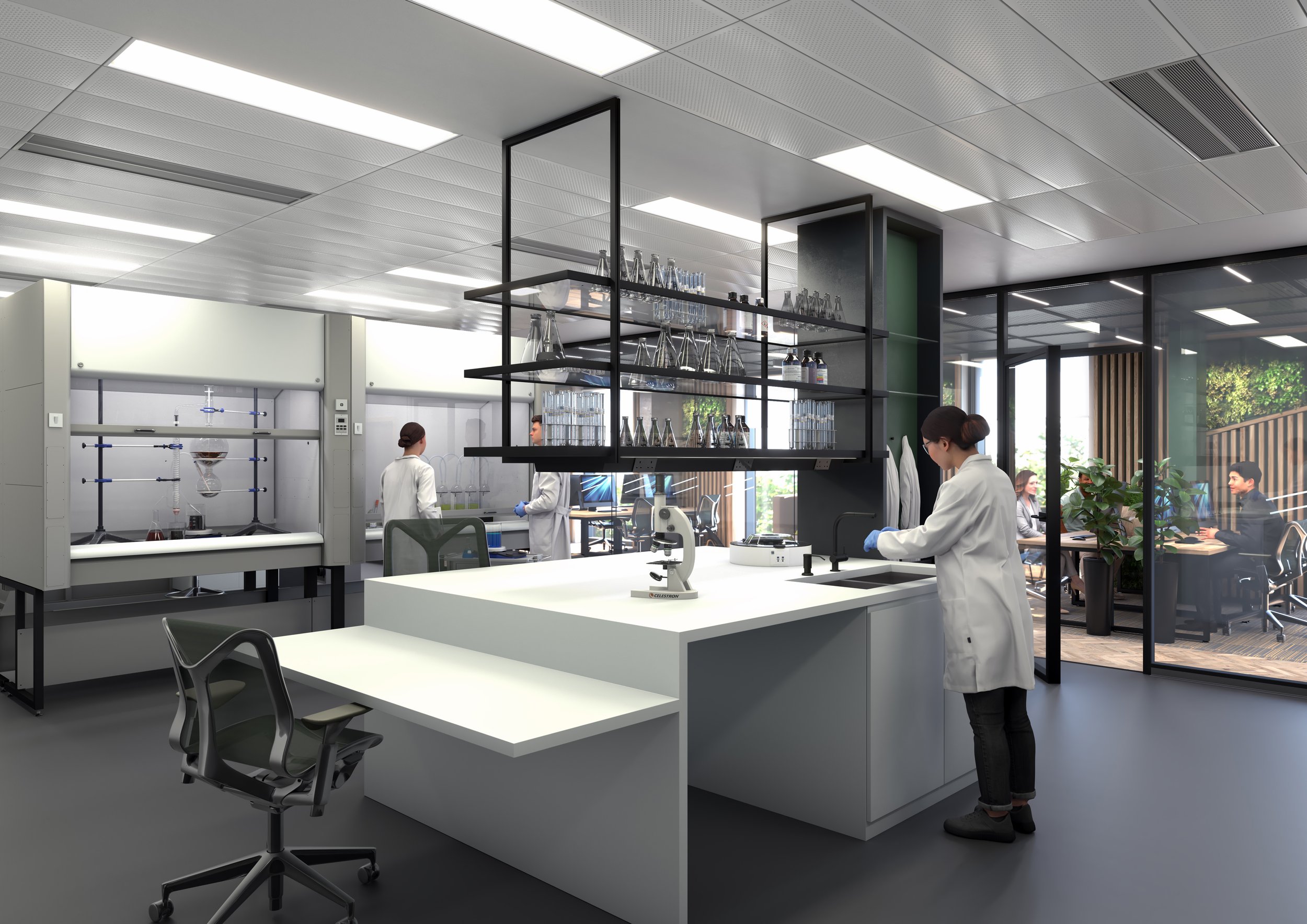
While many Cambridge companies still occupy converted space, there are options presented by purpose-built lab developments designed around flexibility and lab-grade infrastructure. One such example is South Cambridge Science Centre (SCSC) in Sawston. The Science Centre is positioned as a purpose-built R&D hub providing some 138,000 sq ft of flexible laboratory accommodation in its Phase One delivery. The lab space is marketed as “state-of-the-art” and designed for laboratory and office use.
From a laboratory set-up perspective, SCSC is a prime example of how a purpose-built facility can eliminate typical retrofit pain points and deliver strategic advantages in terms of: base-build services capacity, subdivision flexibility, and accommodation designed for lab operations rather than adapted from another use class. For teams weighing speed-to-operation and capex certainty, this category of asset often compares favourably to conversion projects once total cost and schedule risk are modelled.
9) Commercial Structure, Expansion Rights, and Exit Flexibility
Finally, the lease and commercial terms should be treated as part of the lab design:
Ability to expand without relocating
Dilapidations and reinstatement obligations (especially punishing in retrofits)
Landlord contributions to fit-out vs tenant capex
Rights to add plant, exhaust, generators, and external equipment
In a fast-scaling Cambridge environment, future optionality is frequently a valuable asset.
Closing Perspective
A Cambridge laboratory succeeds when scientific ambition is matched by operational discipline: clear definition of hazard and containment requirements, robust COSHH governance, and a building with real lab-grade MEP capacity and logistics. In that context, retrofit facilities can be deceptively attractive but often carry hidden capex and schedule risk, plus long-term operational constraints. Purpose-built options including developments such as South Cambridge Science Centre are increasingly central to how founders and investors reduce delivery risk and protect runway while remaining embedded in the wider Cambridge ecosystem.
South Cambridge Science Centre