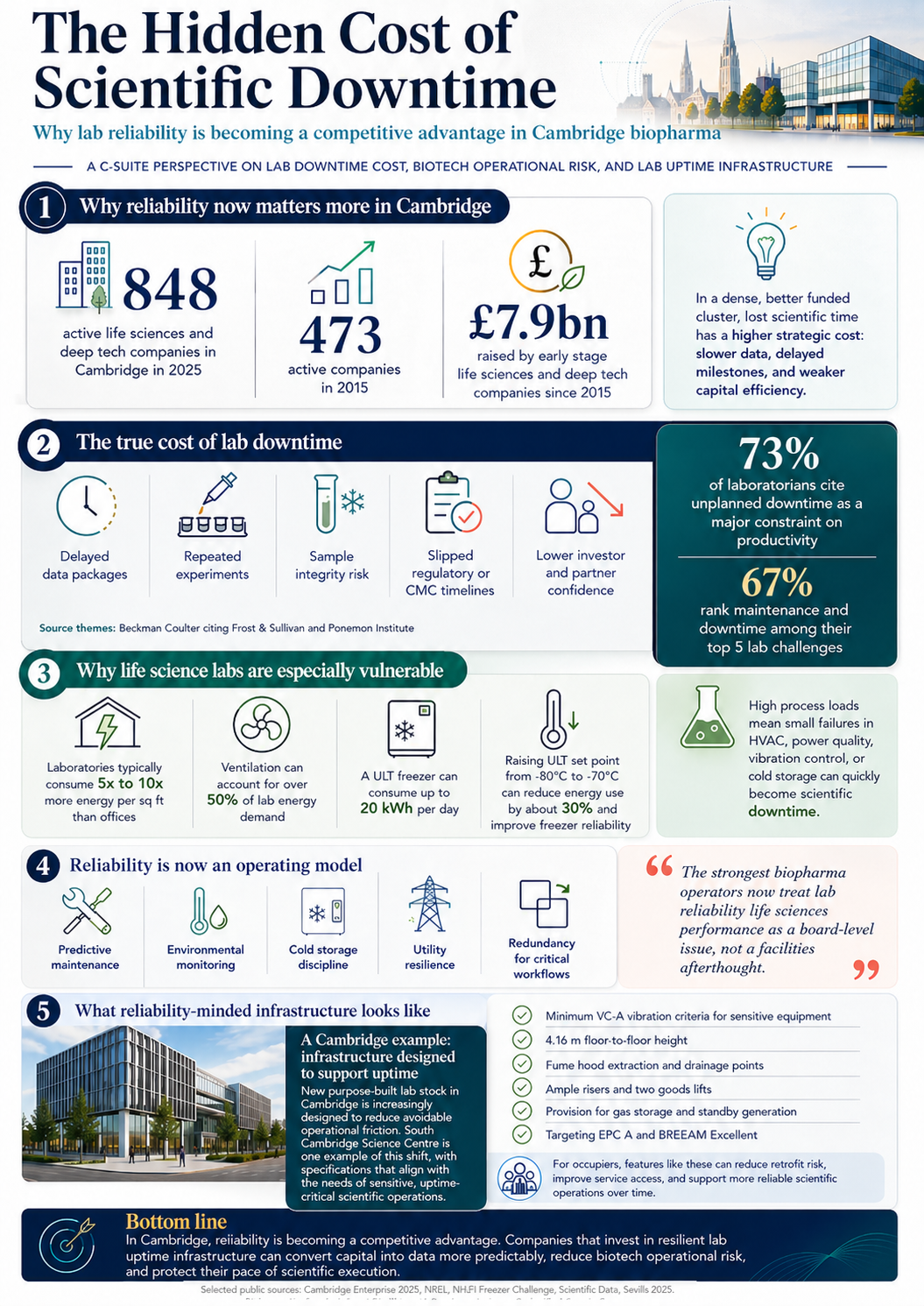
In Cambridge, scientific downtime is no longer a back-office issue. It is a strategic variable. The region’s life sciences and deep tech ecosystem has grown from 473 active companies in 2015 to 848 in 2025, and those early-stage companies have raised £7.9 billion since 2015. Cambridge also attracted £2.49 million of life sciences investment per company in 2024, more than double Oxfordshire and more than 2.5 times Greater London. In a cluster with that level of capital intensity and programme density, lost scientific time has a different meaning than it did a decade ago. It is not just an operational nuisance. It directly affects burn, milestones, partner confidence and the ability to convert funding into data.
That is why the real lab downtime cost is often misunderstood. Most companies still record downtime as an engineering incident: a freezer alarm, a failed autoclave cycle, an analyser fault, a BMS issue, a ventilation deviation, a calibration drift. But the economic damage usually appears elsewhere. It appears in delayed assay release, repeated experiments, sample integrity concerns, postponed IND or CTA support packages, and slower internal decision making. In clinical laboratory settings, published estimates illustrate how large these secondary effects can become. Beckman Coulter, citing Frost and Sullivan and the Ponemon Institute, reports that 73 percent of laboratorians identified unplanned downtime as a leading constraint on productivity, 67 percent ranked instrument maintenance and downtime among their top five challenges, and healthcare organisations faced an average cost of $740,357 per downtime incident. Those are clinical rather than biotech figures, but the directional lesson is clear: when high value lab operations stop, the visible repair cost is usually the smallest part of the financial impact.
Cambridge magnifies that effect because the cluster runs on compressed timelines. CBRE describes Cambridge as one of Europe’s most advanced life sciences hubs, with end-to-end capabilities across discovery, translation and commercialisation. Bidwells’ February 2026 market databook says Cambridge’s office market had its strongest year since 2021, while science and technology occupiers continued to drive demand, with advanced research and AI exerting increasing influence. In that context, the firms that keep programmes moving through infrastructure disruptions are not merely better managed. They are more competitive. Reliability is becoming a differentiator in the same way location, talent density and capital access already are.
The reason is simple. Modern biotech research is more infrastructure sensitive than many executives assume. Flow cytometry, automated liquid handling, mass spectrometry, cell culture, cryogenic storage, imaging, sequencing support labs and GMP adjacent analytical environments all depend on stable utilities and tightly controlled environments. Even when a room is technically “available,” the science may not be reliable if temperature, vibration, humidity, power quality or air handling drift outside a workable range. A National Renewable Energy Laboratory guide notes that laboratories typically consume five to ten times more energy per square foot than offices, and NREL’s later Smart Labs work puts the average lab at around four times the site energy intensity of a typical office. That matters because any building type operating at those loads has less tolerance for weak HVAC control, underpowered backup strategy or poorly planned service access.
This is where lab uptime infrastructure starts to look less like a property issue and more like a scientific one. NREL’s 2024 Smart Labs material notes that laboratories can consume three to ten times more energy than similarly sized commercial buildings and that about 50 percent of lab energy may be wasted through inefficient fume hood operation and ventilation systems. Older constant air volume systems are particularly vulnerable because they force buildings to work harder than necessary while still giving occupiers less control over actual operating conditions. In practice, that translates into higher opex, more stress on plant, and greater exposure to downtime when systems are poorly tuned or overloaded. For fast moving life sciences companies, a building that routinely runs close to its service limits is not just inefficient. It introduces avoidable biotech operational risk.
Cold storage is one of the clearest examples of hidden downtime risk because the damage accumulates quietly. A 2023 Scientific Data paper presented a labelled dataset from 53 ultra-low temperature freezers with operating histories spanning up to 10 years and 46 service report fault events. The paper notes that ULT freezers can consume up to 20 kWh per day and argues for data driven fault detection and diagnostics to maintain reliable operation. NIH makes the same point from an operational angle. Its January 2024 sustainability bulletin says conventional ULT freezers use around 20 kWh daily, roughly equivalent to an average U.S. household, and its 2024 Freezer Challenge results show 110 participants collectively saved 1,454,602 kWh per year, $171,100 per year and 1,072.8 metric tons of CO2e while improving freezer reliability. NIH also states that increasing a ULT freezer set point from minus 80°C to minus 70°C can cut energy use by around 30 percent and improve compressor reliability. Those are energy figures, but the larger implication is reliability: badly managed cold storage is not just expensive, it is a latent sample loss risk.
Reliability risk is not confined to storage. Instrument downtime itself is becoming more measurable and, increasingly, more predictable. A 2025 Lab Medicine study used data from three identical chemistry analysers, recorded 650 downtime events and built a logistic regression model that predicted downtime with 69.2 percent sensitivity and 58.2 percent specificity. The significance of that result is not that it solves maintenance. It is that it shows downtime can be treated as an analytically manageable variable rather than a random inconvenience. For board level decision making, that is an important shift. Once downtime is measurable, it can be incorporated into capital planning, site selection and operating model design.
The consequences become especially acute during the scale up phase. Cambridge’s own market data shows why. Savills reported that by mid 2025 the city had 604,000 sq ft of available laboratory space and that new completions, including The Press and South Cambridge Science Centre, added 203,000 sq ft of purpose-built laboratory enabled stock. Yet the same report recorded 705,000 sq ft of active requirements. Bidwells similarly reported that new completions pushed availability up to 13.2 percent in 2025, even as startups remained cautious and the market continued to be driven by science-based demand. In other words, more space has arrived, but the pressure has not gone away. In that environment, the quality of space matters as much as the existence of space. Companies choosing between technically resilient stock and superficially available stock are making a competitive decision whether they frame it that way or not.
This is also why lab reliability life sciences companies pursue is increasingly linked to the base building, not just the fit out. Knight Frank’s UK lab guidance highlights the importance of slab heights, air change assumptions, fume hood capacity, locations for chillers and backup generators, loading bays and goods lifts. Those are not fringe details. They determine whether a lab can absorb change without destabilising ongoing science. The same guide points out that laboratories demand far more cooling, ventilation and servicing intensity than offices, which is precisely why retrofits so often introduce hidden reliability constraints later. If the building does not have technical headroom, uptime becomes fragile no matter how good the science team is.
Seen through that lens, newer purpose-built stock in Cambridge becomes relevant not because it is newer, but because it is engineered to remove common sources of interruption. South Cambridge Science Centre is a good example of this trend. Its published specification includes minimum VC A vibration criteria for sensitive equipment, 4.16 metre clear height to underside of slab, fume hood extraction, drainage points, ample risers, two goods lifts, and provision for gas storage and standby generation. The scheme also targets EPC A and BREEAM Excellent and is described by the developer as zero fossil fuel and fully electric. For occupiers, those are the kinds of quiet technical characteristics that can improve service access, reduce retrofit stress, support stable equipment operation and lower the probability that the building itself becomes the cause of scientific interruption. That does not eliminate hypothetical downtime, but it does reduce structural sources of downtime, which is exactly the point.
The competitive advantage comes from recognising that reliability is cumulative. No single intervention solves the problem. What matters is whether an organisation builds a system in which freezer management, preventative maintenance, environmental monitoring, backup planning, instrument redundancy, utilities resilience and site selection reinforce one another. The most capable operators increasingly treat reliability as a cross functional discipline. Facilities, lab operations, EHS, QA, IT and programme leadership all have a stake because each relies on uninterrupted output from the others. That is why the most sophisticated labs are moving away from reactive “service call” thinking and toward resilience planning based on predictive maintenance, data visibility and infrastructure headroom.
This has implications for capital allocation as well. Companies often see reliability investments as defensive spending. In Cambridge they should increasingly be viewed as speed investments. If a business can avoid repeating a six week experiment, preserve a full freezer inventory, maintain GMP support analytics without interruption, or prevent a systems failure from delaying a financing milestone, the return is not abstract. It shows up in time, credibility and optionality. That is especially true in a region where international investors are now involved in nearly 40 percent of deals and where the ecosystem’s investment intensity has risen sharply over the past decade. In that environment, firms that repeatedly lose time to infrastructure instability become harder to underwrite.
The hidden cost of scientific downtime, then, is that it rarely appears on one obvious line in the budget. It is spread across burn, staffing, rework, lost samples, delayed milestones and weakened confidence in the operating model. Cambridge’s next tier of winners is likely to include not just the companies with the strongest platforms, but the ones that understand uptime as part of platform quality. In a cluster as capital rich and technically demanding as Cambridge, reliability is no longer the background condition for doing science. It is increasingly one of the ways serious companies outperform.