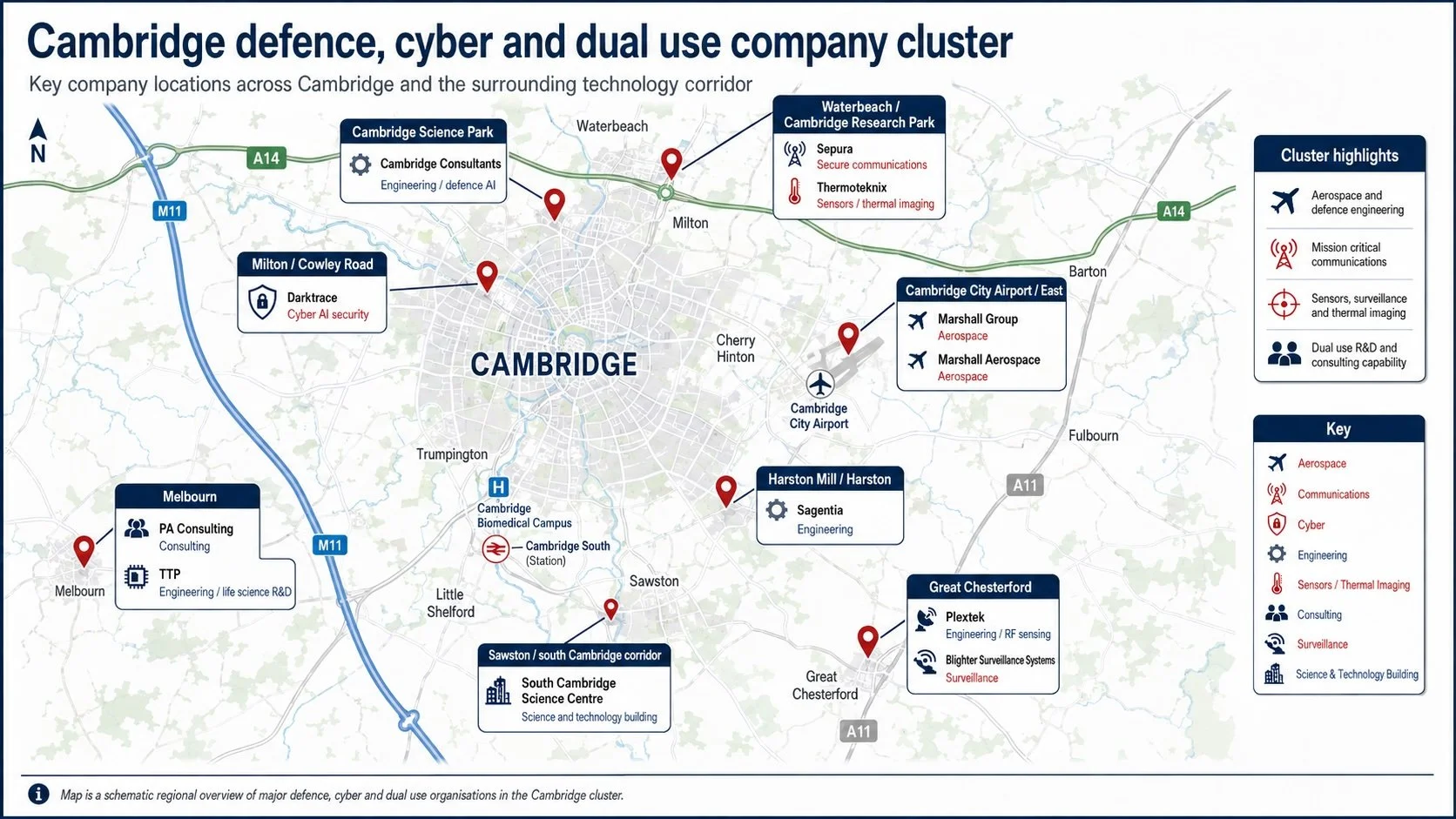
The defence sector is no longer defined only by major contractors, weapons systems and large industrial facilities. A growing share of defence capability is now being shaped by companies working in software, artificial intelligence, cyber security, autonomous systems, sensors, communications, quantum technologies, biosecurity and advanced engineering. Many of these businesses operate across both civilian and defence markets, and that dual use character is changing the property requirements of the sector.
For these companies, a conventional office is often insufficient and a traditional defence estate may be unnecessary. What many need is a high quality science and technology building that can combine laboratory space, engineering areas, secure project rooms, resilient data infrastructure, meeting space, technical services and room for growth. The defence property conversation is therefore becoming less about legacy industrial accommodation and more about research and innovation environments that support complex, fast moving technical work.
Cambridge is increasingly relevant to that conversation. The city is not a classic defence manufacturing centre. Its strength lies elsewhere. It has deep university research, strong life sciences, advanced engineering, AI capability, software expertise, communications knowledge and a dense network of specialist companies. That makes it attractive to defence technology businesses whose work sits at the edge of science, security and commercial innovation.
The government’s defence policy direction helps explain why this matters. The UK is seeking faster routes from promising technology to operational use, particularly in areas where the public sector can draw on commercial research. Defence innovation is increasingly looking beyond the established supplier base to smaller, specialist and growth stage companies. This creates demand for buildings that can support research teams, technical trials, confidential collaboration and rapid scale up.
The Defence and Security Accelerator is an example of that shift. Its model gives small companies, university linked teams and specialist technology businesses a pathway into defence problems without first becoming large prime contractors. That has practical property implications. A company developing autonomous systems, cyber resilience tools or advanced sensing may need a professional R&D base long before it needs a large manufacturing site. It may also need to move quickly from a small technical team to a larger programme group after grant funding, customer engagement or partnership activity.
Science parks and specialist technology buildings are well suited to this pattern because they are designed around growth, proximity and technical infrastructure. The most successful examples are no longer just collections of buildings. They combine workspace, specialist facilities, networking, business support, access to talent and connections into academic, clinical or public sector institutions. The rise of operators such as Bruntwood SciTech in other UK regions shows how strongly the market has moved toward managed science and innovation ecosystems rather than ordinary property provision.
For defence technology companies, that ecosystem model can be particularly valuable. These businesses often need access to engineers, data scientists, software developers, physicists, biologists, cyber specialists and commercial advisers. They also need credibility with customers, investors and public sector stakeholders. A location inside a serious science and technology cluster can therefore help with recruitment, partnership formation and market confidence.
Cambridge offers that combination in a concentrated form. It gives companies proximity to the University of Cambridge, specialist consultancies, technology founders, life sciences businesses, research hospitals, investors and experienced operators. A cyber defence company may value the software and security talent. An autonomy company may value engineering and AI skills. A biosecurity company may value the region’s life sciences base. A sensing or communications company may value the wider deep technology ecosystem.
The property requirement is correspondingly varied. Some defence technology firms may need wet laboratory space. Others may need dry lab environments, electronics benches, clean technical rooms, secure offices, demonstration areas or controlled meeting space. Many will need a blend of functions. Their premises must support confidential work without isolating teams, and technical space without losing the quality of office and collaboration areas.
This is why generic offices can fall short. A defence technology occupier may need enhanced power, cooling, data resilience, controlled access, equipment routes, workshop capability and the option to configure rooms around sensitive projects. It may also need flexible expansion so that a funded programme can grow without forcing the company into relocation. In a sector where programme timing matters, property friction can become a commercial disadvantage.
Transport is part of the calculation. Defence and dual use companies often receive visits from customers, public sector bodies, strategic partners, investors and technical advisers. They may need access to London, airports and regional networks while still drawing on Cambridge’s talent pool. The opening of Cambridge South station strengthens the appeal of the southern Cambridge corridor, particularly for companies that want access to the Cambridge Biomedical Campus area and wider city without taking space in the most constrained central locations.
South Cambridge Science Centre is a modern science and technology building that can suit defence technology and dual use companies looking for high specification, flexible R&D accommodation close to the Cambridge ecosystem. For this emerging occupier group, that distinction matters.
SCSC’s relevance lies in four practical points. It offers high quality specification, flexible laboratory and office accommodation, a strategic location close to Cambridge University and the Cambridge South cluster, and a value proposition that may be attractive compared with more constrained core locations. These characteristics align well with the needs of companies working at the intersection of defence, science and technology.
Key considerations of security, infrastructure, customer access, staff recruitment, flexibility, confidentiality and future expansion are also positively addressed. Relative cost still matters. If a building can provide access to Cambridge’s research and innovation economy at a lower rentthan the most pressured locations, it offers a compelling occupational case.
There is also a wider market trend at work. Defence innovation is becoming more scientific, more digital and more dependent on technologies developed outside the traditional defence supply chain. That means more companies are looking for premises in places associated with research, engineering, life sciences, data and advanced technology. Cambridge science parks and specialist buildings are likely to benefit from this shift because the region already contains many of the ingredients that these companies need.
For science and technology buildings in Cambridge such as SCSC this trend speaks directly to this new occupier profile. The target is not only the established defence contractor. It is the AI company working on autonomous decision support, the cyber firm developing resilient systems, the sensor business serving both commercial and defence users, the engineering company building prototypes, the biosecurity company working across health and national resilience, and the dual use technology firm that needs credibility with both private and public sector customers.
This in summary is the market story. Defence R&D is moving closer to the research and innovation economy. The companies shaping the next phase of capability often look more like advanced science and technology businesses than legacy defence occupiers. They need buildings that reflect that reality. South Cambridge Science Centre is well placed to meet that demand.