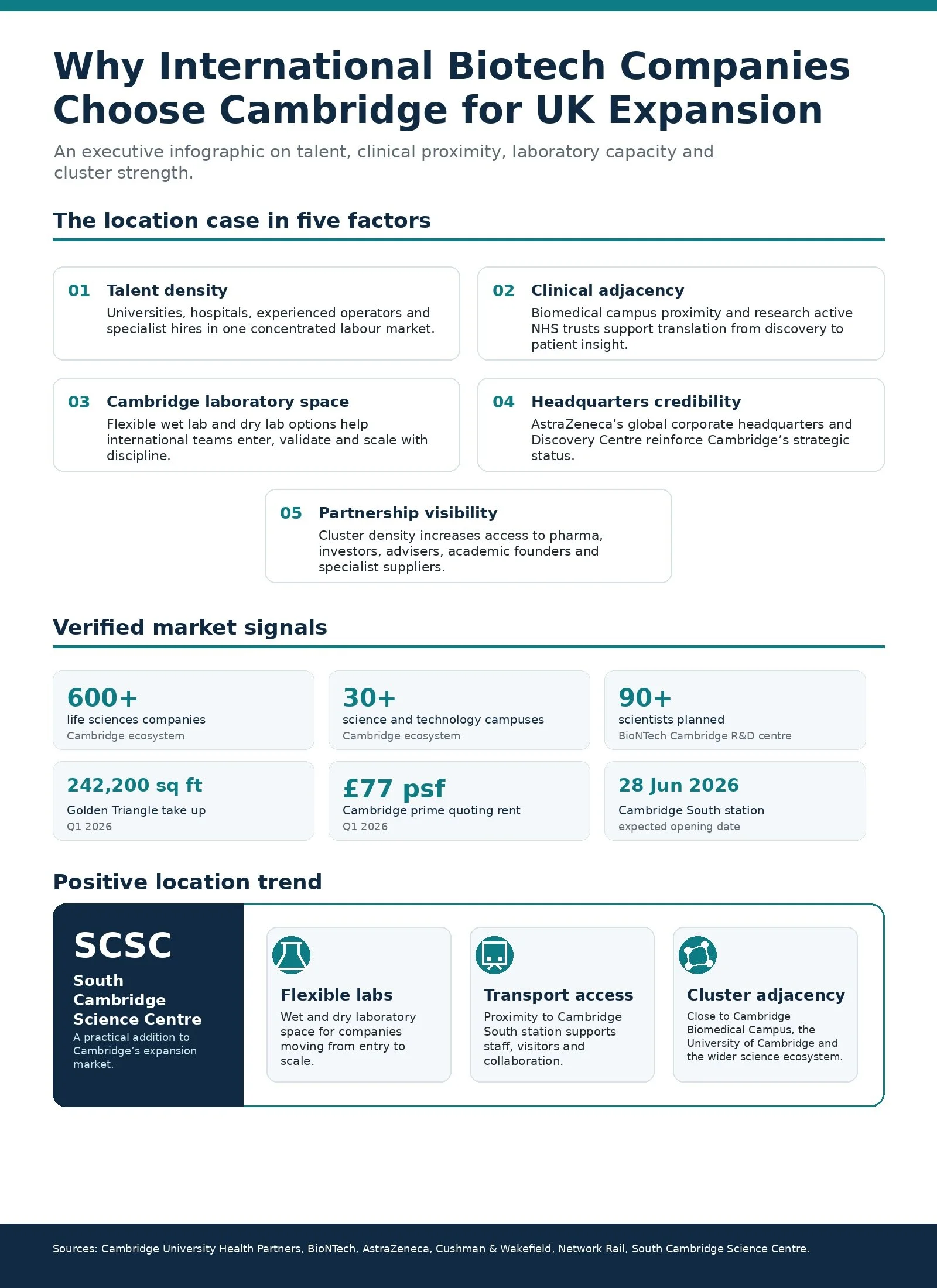
International biotech companies choosing a UK expansion location are making a decision about execution risk. The question is where a company can recruit faster, form credible research partnerships, access clinical insight, secure appropriate laboratory space and build relationships with investors and pharmaceutical companies. Cambridge remains one of the UK’s strongest answers because it combines scientific depth, clinical infrastructure, specialist property, global reputation and commercial networks in a compact geography.
The first reason is the concentration of life sciences capability. Cambridge University Health Partners reports that the local ecosystem includes six major academic institutions, more than 30 science and technology campuses, over 600 life sciences companies and three research active NHS Trusts. For overseas management teams assessing biotech expansion UK options, that density matters. It gives a new entrant immediate access to a mature market of researchers, clinicians, founders, service providers and technical talent rather than requiring the company to assemble those networks from the beginning.
The wider Cambridge business base strengthens that position. The University of Cambridge states that the Cambridge Cluster contains more than 4,500 knowledge intensive firms, employs more than 75,000 people and generates £25 billion in turnover. Those figures show that Cambridge is more than a university city with strong science. It is a functioning innovation economy with the supporting skills required to help companies move from discovery into growth.
For international biotech companies, this matters because expansion is rarely a single function decision. A company may begin with a research team, then need senior hires, intellectual property support, regulatory advice, finance leadership, clinical operations expertise and commercial partners. Cambridge gives management teams a deeper bench across those functions than most UK locations. That depth helps make a UK operation more than a small satellite office.
The presence of major pharmaceutical companies also gives Cambridge strategic credibility. AstraZeneca identifies Cambridge as the home of its global corporate headquarters and flagship research and development facility, The Discovery Centre. The company says its Cambridge base connects it with academic and industry networks, scientific talent and collaboration opportunities. For a board considering a UK biotech headquarters, that is an important signal. It demonstrates that Cambridge can support global leadership, not only early stage research.
BioNTech provides a more recent example of Cambridge’s international pull. In 2025, the German immunotherapy company announced plans for a Cambridge R&D centre focused on genomics, oncology, structural biology and regenerative medicine, with capacity for more than 90 highly skilled scientists. These are cutting edge disciplines that depend on advanced research capability and specialist recruitment. BioNTech’s decision illustrates why Cambridge remains attractive to companies working at the frontier of modern medicine.
Clinical proximity is another major driver. The Cambridge Biomedical Campus reported in 2025 that it contributes £4.7 billion annually to the UK economy. Its value to biotech companies lies in the combination of hospitals, research institutes, academic expertise and industry presence. Companies developing innovative products need clinical insight early, especially where trial design, biomarkers, patient stratification and translational evidence will influence investor confidence.
This is particularly relevant because clinical trials remain a competitive pressure point for the UK. The ABPI’s 2025 clinical trials report recorded a 35.7 percent increase in UK industry trial initiations in 2024, rising from 426 in 2023 to 578 in 2024. The same report also highlighted continuing weaknesses in patient recruitment and trial delivery. For international companies, this makes location choice more important. Strong research hospitals, experienced investigators and translational networks can improve the practical conditions for clinical development.
The national policy context is supportive, while still demanding. The UK Government’s Life Sciences Sector Plan states that pharmaceutical R&D accounted for 17 percent of all UK business R&D in 2023, the largest share of any product area. The plan also recognises that the UK is strong in discovery and weaker in commercialisation and adoption. Cambridge helps address that imbalance because it combines discovery science with company formation, clinical infrastructure, specialist investors and connections to pharmaceutical companies.
Cambridge laboratory space is therefore a strategic issue rather than a simple facilities requirement. Biotech companies need different types of space at different stages. A platform company may require a blend of wet lab, dry lab and computational space. A therapeutics company may need specialist utilities, containment, equipment routes and room to expand. A diagnostics or engineering biology company may need adaptable technical infrastructure as experiments move from proof of concept to repeatable development.
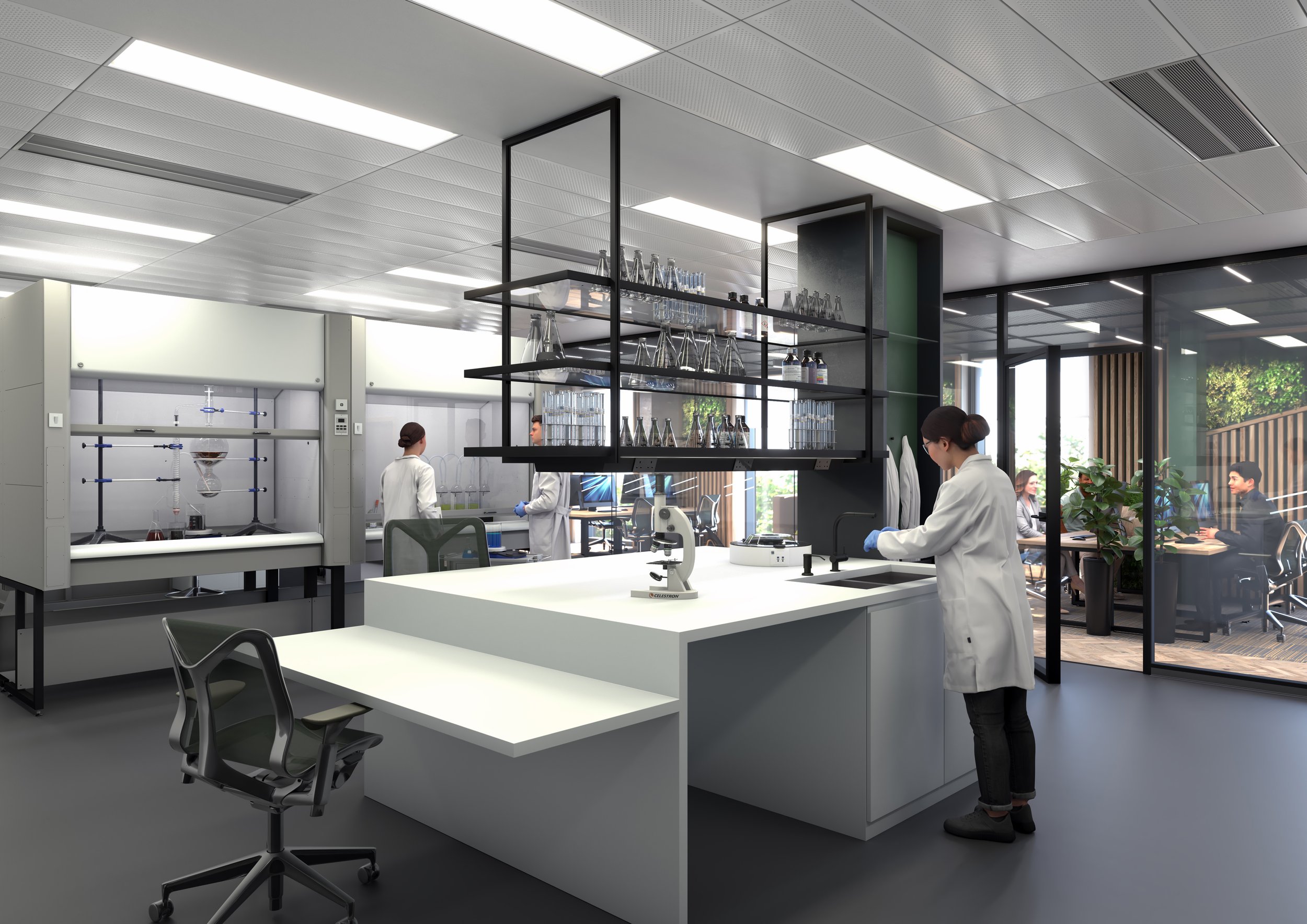
South Cambridge Science Centre
Independent market evidence shows continuing demand. Knight Frank reported that science and innovation leasing across the Golden Triangle reached 234,779 sq ft in the first quarter of 2026, which was 43.2 percent above the five year average and 6 percent ahead of the same period in 2025. This suggests that high quality laboratory and innovation space remains in demand despite a more selective financing environment. For companies entering Cambridge, securing the right premises at the right stage can influence capital efficiency as well as operational performance.
CBRE’s Cambridge life sciences market profile describes the city as one of Europe’s most advanced life sciences hubs, with real estate infrastructure that supports the innovation lifecycle from discovery through translation and commercialisation. That breadth is important. International companies are not looking only for a building. They are looking for a place where research, clinical development, hiring and commercial engagement can happen within the same operating environment.
Transport is becoming a more visible part of that equation. Network Rail says Cambridge South station is expected to open to the public on 28 June 2026 and will improve connectivity to the biomedical campus and the wider region. For international biotech companies, this has practical value. Easier movement supports recruitment, site visits, investor meetings, hospital access and collaboration between teams.
South Cambridge Science Centre fits into this wider pattern as part of the market’s response to demand for additional specialist space around the southern Cambridge corridor. This article does not rely on SCSC website material. The relevant independent evidence is market based. Savills identified Frontier IP’s 18,000 sq ft acquisition at South Cambridge Science Centre as the largest laboratory letting in Cambridge during the first half of 2025. Savills also noted that the space would support incubation activity for Frontier’s portfolio companies.
The Frontier IP transaction is significant because it links property demand with company formation. Frontier IP announced a strategic partnership to create a Cambridge innovation hub and stated that it expected portfolio companies and other early stage businesses to use the facility. For the wider Cambridge science park market, this is a positive signal. It shows that specialist locations are being used to support deep technology and life sciences businesses, rather than simply absorbing surplus office demand.
The southern Cambridge corridor benefits from this type of additional capacity. Companies that want proximity to the biomedical campus, access to Cambridge South connectivity and room to scale need credible options beyond the most constrained central locations. SCSC is relevant because it adds choice to the market in a location that can support laboratory users, commercialisation teams and growth stage occupiers. The point is measured but important: Cambridge’s appeal improves when the city can offer more than one route into the ecosystem.
For international biotech companies, Cambridge also offers reputational compounding. Each major company, university spinout, clinical research group, investor backed platform and specialist science location reinforces the decision case for the next entrant. That cumulative effect is difficult for emerging clusters to copy. It allows new arrivals to operate in a market where counterparties already understand life sciences risk, financing cycles, translational research and the requirements of regulated innovation.
The conclusion is clear. Cambridge attracts international biotech companies because it reduces multiple expansion risks at once. It offers talent, clinical infrastructure, pharmaceutical partners, investors, research excellence, specialist property and improving transport links. For boards considering biotech expansion UK strategy, Cambridge is more than a prestigious postcode. It is a practical environment for turning scientific ambition into clinical trials, partnerships and innovative products.Savills reported that Frontier IP’s 18,000 sq ft deal at South Cambridge Science Centre was Cambridge’s biggest laboratory lease in the first half of 2025.