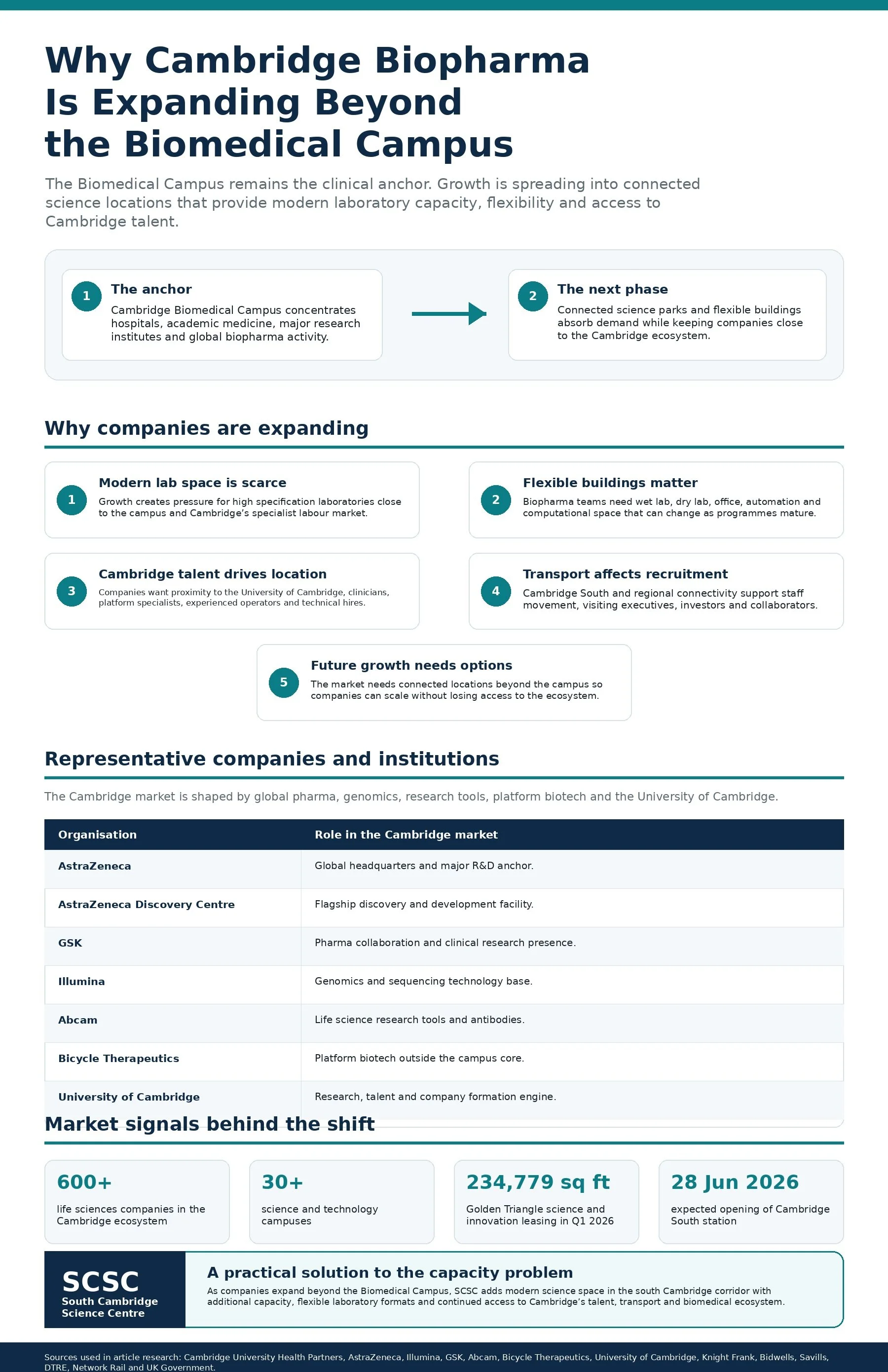
Cambridge’s Biomedical Campus remains one of the most important concentrations of life sciences activity in Europe. It brings together hospitals, academic medicine, pharmaceutical research, specialist suppliers and global company headquarters in a single high value district. Yet the next phase of Cambridge’s biopharma growth is increasingly spreading beyond the campus boundary. This is a sign of market strength rather than dispersal. Leading companies are expanding because the ecosystem has outgrown a single location model.
The pressure begins with demand. Cambridge University Health Partners describes the wider Cambridge life sciences ecosystem as including six major academic institutions, more than 30 science and technology campuses, over 600 life sciences companies and three research active NHS Trusts. That scale explains why the Biomedical Campus has become an anchor, while the surrounding science property market has become essential support infrastructure. A global company can gain proximity to clinical research and academic medicine on the campus, yet still require additional space elsewhere for discovery teams, data groups, manufacturing support, commercial functions or growth stage laboratory work.
AstraZeneca illustrates the power and pressure of the campus model. Its Cambridge base is home to the company’s global corporate headquarters and flagship research and development facility, The Discovery Centre. AstraZeneca says the site connects it with academic and industry networks, scientific talent and collaboration opportunities. The Discovery Centre also houses more than 2,000 scientists working in drug discovery and development. This is precisely the type of anchor presence that makes the campus globally significant, yet it also shows why nearby capacity becomes critical. When one company alone can concentrate thousands of highly skilled people around a single research hub, the wider area must provide room for suppliers, partners, spinouts and related occupiers.
The issue is partly a shortage of modern laboratory space, and partly a shortage of the right kind of space in the right locations. Cambridge has seen waves of new development, yet many biopharma occupiers need specialist buildings that can adapt to changing scientific workflows. Traditional offices cannot simply absorb biology, chemistry, sequencing, automation and data intensive work without major technical compromise. Bidwells reported that Cambridge laboratory take-up reached a seven year high in 2023 after the delivery of new lab stock, while a significant shortfall of 850,000 sq ft still persisted. More recent market data from Savills showed Cambridge office and laboratory take up reaching 273,000 sq ft by the end of the first half of 2025, 33 percent above the five year average.
That demand is changing in character. Modern biopharma companies often need buildings that can flex between wet lab, dry lab, office, collaboration, automation and computational work. The boundary between biotech and technology is becoming less useful as companies use AI, genomics, high throughput screening and advanced analytics to accelerate discovery. Illumina’s Cambridge Solutions Centre, located within its European headquarters, is used as a working lab for training, collaboration studies and testing new technologies. That operating model needs more than generic accommodation. It needs adaptable, technically credible space connected to a skilled labour market.
This explains why the wider Cambridge science market has become strategically important. The Biomedical Campus remains the centre of clinical gravity, while places such as Granta Park, Cambridge Science Park and emerging south Cambridge locations provide additional formats for growth. Bicycle Therapeutics, for example, is based at Granta Park in Great Abington, outside the Biomedical Campus, while Illumina Cambridge Limited is registered at Granta Park. These locations demonstrate that companies can remain inside the Cambridge talent and investor ecosystem while operating beyond the campus itself.
GSK adds another dimension. The NIHR Cambridge Biomedical Research Centre describes the campus as combining patient care, world class institutes and drug discovery through GlaxoSmithKline’s Clinical Unit and AstraZeneca’s global research headquarters. GSK has also announced a five year collaboration with the University of Cambridge in kidney and respiratory disease, with a focus that includes AI enabled research. This is the Cambridge model at work: pharmaceutical companies, university science and clinical research interacting across institutional boundaries. Expansion beyond the campus supports that model by giving companies more ways to place teams close to the ecosystem without forcing every function into the same constrained district.
Abcam shows how the campus has historically attracted companies seeking a headquarters identity within the biomedical cluster. The company moved to a purpose-built global headquarters on Discovery Drive at the Cambridge Biomedical Campus in 2019. Its later acquisition by Danaher for approximately $5.7 billion reinforced the international value attached to Cambridge life science assets. The lesson for the next generation of companies is clear: campus presence can create credibility, yet future growth may require a wider real estate strategy across Cambridge and South Cambridgeshire.

South Cambridge Science Centre
Transport is another reason expansion is spreading. A single dense campus can become less efficient if staff, visitors and collaborators struggle to reach it. New capacity encourages diffusion. According to the Department for Transport, the new Cambridge South station will provide up to nine trains an hour to central Cambridge and a direct link to the Biomedical Campus which is bound to encourage life science and pharma organisations to locate further to the south of Cambridge. The government also states that the Biomedical Campus contributes £4.7 billion annually to the UK economy, with that figure expected to rise to £18.2 billion by 2050 alongside a doubling of current employees. Growth on that scale requires a broader geography, with connected sites that can absorb demand and keep the labour market accessible.
Flexible buildings are central to that future. A young therapeutics company may need fitted laboratory space quickly, then require more technical capacity after funding. A genomics or diagnostics company may need a higher ratio of data work to wet lab work. A pharmaceutical company may want collaboration space near academic groups while keeping other functions elsewhere. A successful building must therefore offer adaptability, technical resilience and expansion logic. The Greater Cambridge Growth Sectors Study identified the need for high quality modern workspaces, larger cluster settings, amenities and good public transport, while recognising that even successful life science locations such as the Biomedical Campus and Cambridge Science Park must evolve.
South Cambridge Science Centre is relevant because it addresses one of the core problems facing the market: companies need additional modern capacity close enough to Cambridge’s talent and clinical infrastructure to be useful, while offering a practical alternative to the most constrained campus locations. Independent market reporting from DTRE stated that phase one of Abstract’s South Cambridge Science Centre brought about 138,500 sq ft of highly flexible laboratory space to the Cambridge market. Savills also identified Frontier IP’s approximately 18,000 sq ft acquisition at South Cambridge Science Centre as the largest Cambridge laboratory letting in the first half of 2025. That matters because SCSC is a response to a real expansion problem: the market needs credible locations where growing science companies can secure space without losing connection to Cambridge’s biomedical economy.
The Frontier IP transaction also shows how demand is shifting toward ecosystems inside buildings. Frontier IP announced a strategic partnership to open an innovation hub at South Cambridge Science Centre, with space intended to support early-stage companies in deep technology and life sciences. This is a useful model for Cambridge’s next phase because growing companies often need more than square footage. They need commercialisation support, investor visibility, peer companies and access to technical talent. SCSC’s value is therefore further strengthened when understood as part of a broader expansion pattern around south Cambridge, rather than solely as a lower-cost alternative to the Biomedical Campus.
Access to Cambridge talent remains the decisive thread connecting all of these decisions. The University of Cambridge, the hospitals, pharmaceutical companies, sequencing specialists, platform biotechs and research institutes create a labour market that cannot be replicated quickly. Companies expand beyond the Biomedical Campus because they want to stay near that talent while finding buildings that fit their next operational stage. That is why the city’s growth is becoming more polycentric. The campus provides the clinical and institutional centre of gravity. The surrounding science parks and laboratory schemes provide the space, flexibility and resilience needed for future growth.
The strategic conclusion is straightforward. Cambridge’s leading biopharma companies are expanding beyond the Biomedical Campus because success has created pressure. AstraZeneca, GSK, Illumina, Abcam and Bicycle Therapeutics each demonstrate different aspects of the same market: global scale research, clinical collaboration, genomics infrastructure, commercial headquarters capability and specialist platform science. The next stage of growth depends on modern lab space, flexible buildings, better transport and locations that can support companies as they mature. South Cambridge Science Centre fits into that story as a practical solution to the capacity challenge, adding another route for companies that need Cambridge access without being limited to the campus itself.